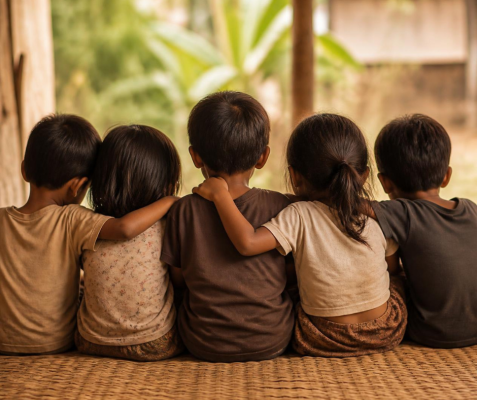
Htoo is eight now, and if you visited his classroom you might not pick him out right away. He is one of the quieter ones, a boy who watches before he speaks and takes in a room before he joins it. He is in first grade, working out the shapes of letters and the rhythm of a school day, sitting shoulder to shoulder with children who have become something like siblings to him. Three years ago, none of this was a given.
Htoo comes from Kayah State, where the care of a child has never been thought of as one family’s job alone. When both of his parents died, he was five years old and suddenly without the people who were meant to raise him. In many places, that is where a child’s story turns frightening. But in his community there is an understanding, older than any of us, that a child is never meant to be left on his own. The chief of his tribe made the decision himself, choosing to bring Htoo to our shelter because he believed it was where the boy would be safe and able to go to school.
It would be easy to hear that a child was sent away and imagine abandonment. This was the opposite. It was a community deciding that this child still belonged to them, and then acting on it.
The first stretch was quiet, the way it often is for a small child learning a new place. There were meals at the same time each day and a bed that stayed his, and the same grown-ups were there in the morning and there again at night. Slowly, that steadiness did its work. The watching turned into taking part, and the quiet turned into the easy noise of a child who feels safe.
Now, three years in, the shelter is simply where Htoo belongs. His caregivers describe him as gentle and observant, a boy growing steadily into a more secure version of himself and a little more confident with each passing season. He is learning and he is known by name, and there are people around him who would notice in a heartbeat if he were missing from the room.
We think about children like Htoo whenever someone asks what it really takes to raise a child who has lost so much. The answer, over and over, is that no one does it alone. Children are carried by communities: by the people near them who step in when loss makes it necessary, and by people much farther away who choose to help carry the weight from where they are.
That is what care looks like when it is shared, a quieter and steadier kind of love than the world usually tells stories about. Htoo is proof of what it can build.